

Survey Says: Tempo Doesn’t Matter. So Why Do We Still Use It?
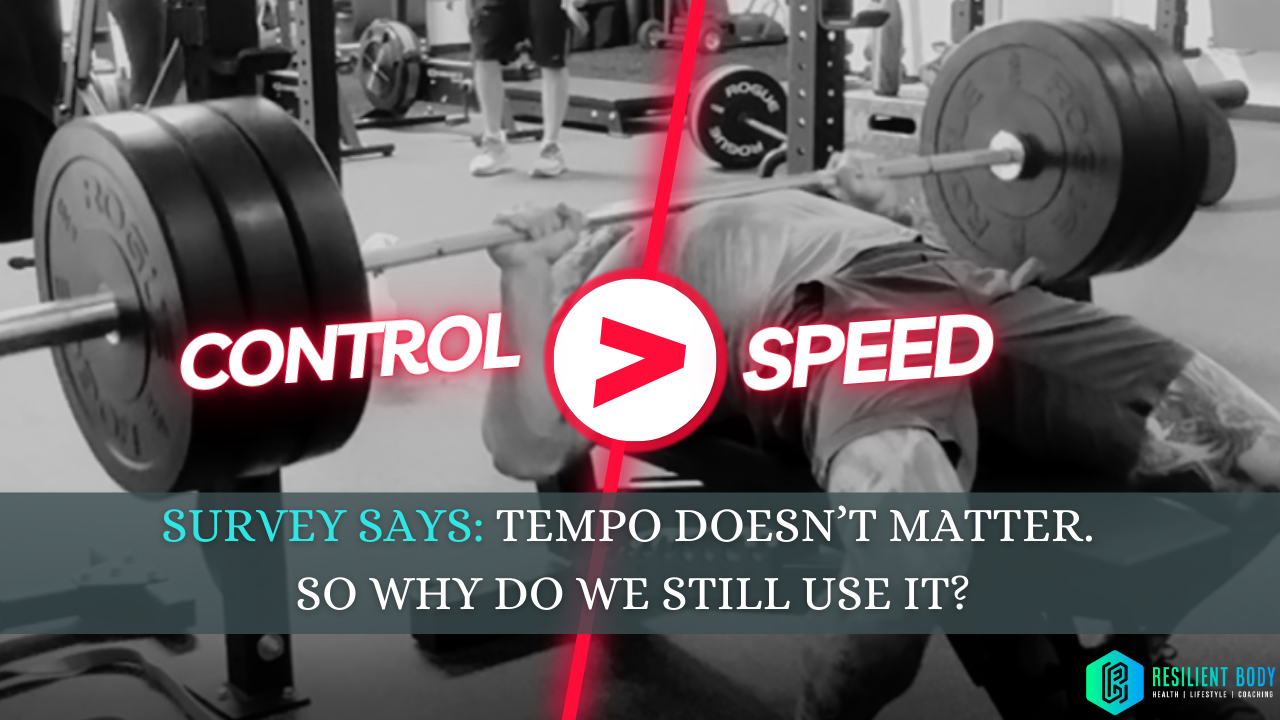
If you spend any time around lifting research or fitness content online, you’ve probably heard some version of this:
“Tempo doesn’t matter for muscle growth.”
And broadly speaking, that statement is supported by research.
Several studies and reviews have shown that when total volume is equated and sets are taken close to failure, muscle growth is similar across a fairly wide range of repetition speeds.
For example:
Schoenfeld et al., 2015 (Journal of Strength and Conditioning Research) found similar hypertrophy outcomes between slower and moderate repetition durations when effort and volume were controlled.
Pereira et al., 2016 (Sports Medicine meta-analysis) concluded that repetition durations between roughly 0.5 and 8 seconds per rep do not meaningfully impact muscle growth when sets are performed near failure.
Grgic et al., 2018 (Sports Medicine review) suggested that extremely slow tempos may impair strength development, but typical controlled tempos do not appear superior for hypertrophy compared to self-selected speeds.
So yes. In a controlled environment, tempo may not dramatically change muscle size outcomes.
Which raises a fair question.
If tempo “doesn’t matter for several outcomes,” why do we still use it?
Because hypertrophy is not the only thing that matters.
And research design does not always reflect real life.
What Those Studies Actually Tell Us
Most tempo research shares a few common features:
Often conducted in untrained or recreationally trained lifters
Short-term interventions, typically 6 to 10 weeks
Volume equated across groups
Sets performed to or near failure
Strict supervision to ensure compliance
Under those conditions, rep speed within a normal range does not seem to meaningfully change hypertrophy outcomes.
That is useful information.
It tells us that muscle growth is largely driven by:
Mechanical tension
Proximity to failure
Sufficient volume
Possibly other mediating factors
Not by obsessing over whether the eccentric was 2 seconds or 3.
But that does not mean tempo is useless.
It means tempo is not a magic hypertrophy hack.
That is a very different claim.

We Don’t Use Tempo to “Hack” Muscle Growth
We use tempo for different reasons.
1. Tempo Is a Teaching Tool
For newer lifters especially, tempo improves:
Positional awareness
Control through range
Stability under load
Quality of execution
Most people do not struggle because their reps are too slow. They struggle because they rush, bounce, shorten range, or rely on momentum. Tempo slows things down enough for people to actually feel positions and own them. That matters more than shaving half a second off a rep.
2. Tempo Builds Tolerance in Longer Ranges
Many aches and tweaks are not caused by slow reps.
They are caused by being weak in deeper or lengthened positions, not being prepared for a given stress, or fluke circumstances .
Controlled eccentrics and pauses:
Increase time spent in challenging joint angles
Improve strength at end range
Gradually expose tissues to load where they are often least prepared
Hypertrophy studies rarely measure joint comfort or long-term training sustainability. We do because many of our clients have been training with us for years. Tempo is one way to build capacity in positions that people would otherwise rush through.
3. Tempo Raises Challenge Without Raising Load
Sometimes the goal is not to add more weight.
Sometimes someone:
Slept poorly
Is in a high-stress work season
Is rebuilding after time off
Is managing joint irritation
In those cases, tempo allows us to increase internal demand or work through things without increasing external load.
A slower eccentric or controlled pause can:
Raise perceived effort
Increase time under tension
Improve contraction quality
Allow you to train through things versus avoid
Sometimes help with tissue repair
This is all without simply stacking plates on the bar. That flexibility is valuable, especially for adults balancing real life.
4. Tempo Keeps Reps Honest
Research assumes compliance but real life is MUCH messier.
Without tempo, many lifters:
Cut depth/range of motion
Rush through fatigue
Bounce out of or miss bottom positions
Turn strength work into momentum work (even though sometimes this is ok ;) )
Tempo creates structure. It gives us a shared standard of what a rep should look and feel like. That consistency improves training quality over time.
What Tempo Is Not
Tempo is not mandatory. Tempo is not magic. Tempo is not required for every lift or every training block.
There are phases where we move explosively, where we lift heavy with natural speed, and where we intentionally control the eccentric.
Good programming is about using many effective tools.

The Bigger Picture
Hypertrophy studies often run 6 to 10 weeks.
We coach people for years.
Research asks:
“Does tempo change muscle size when volume and effort are controlled?”
That is a fair and useful question.
We ask:
Does this improve control?
Does this build joint tolerance?
Does this help someone feel more stable?
Does this allow them to train hard next month and next year?
Those are different questions and while tempo may not dramatically change muscle growth in a lab, it does contribute to other very meaningful outcomes.
In real people, in real seasons of life, it often improves how training feels, how joints tolerate load, and how well someone executes their work.
That is enough reason to keep it in the toolbox.
📣 Quick Announcements:
🏋️♂️ We’re in the process of expanding our training formats, including:
Semi-Private Training — small groups with individualized programming, close coaching attention, and a balance of personal focus and community.
Pod-Style Training — consistent small groups training together on a shared framework, emphasizing progression, accountability, and sustainability.
App-Based Training — ability to follow a program in and out of the gym studio and also track your historic data and personal bests. Stay tuned as we pilot these with small group…
These options are designed to create more flexibility, more access to coaching, and more ways to train well depending on where you’re at and what you need.
New Personal Training Slots Available – Book a consult if you’re ready to level up
💬 Got questions? Reply here or ask your coach next time you're in