

Your Body Doesn't Know It's Wednesday - Why one meal matters far less than the patterns you repeat.
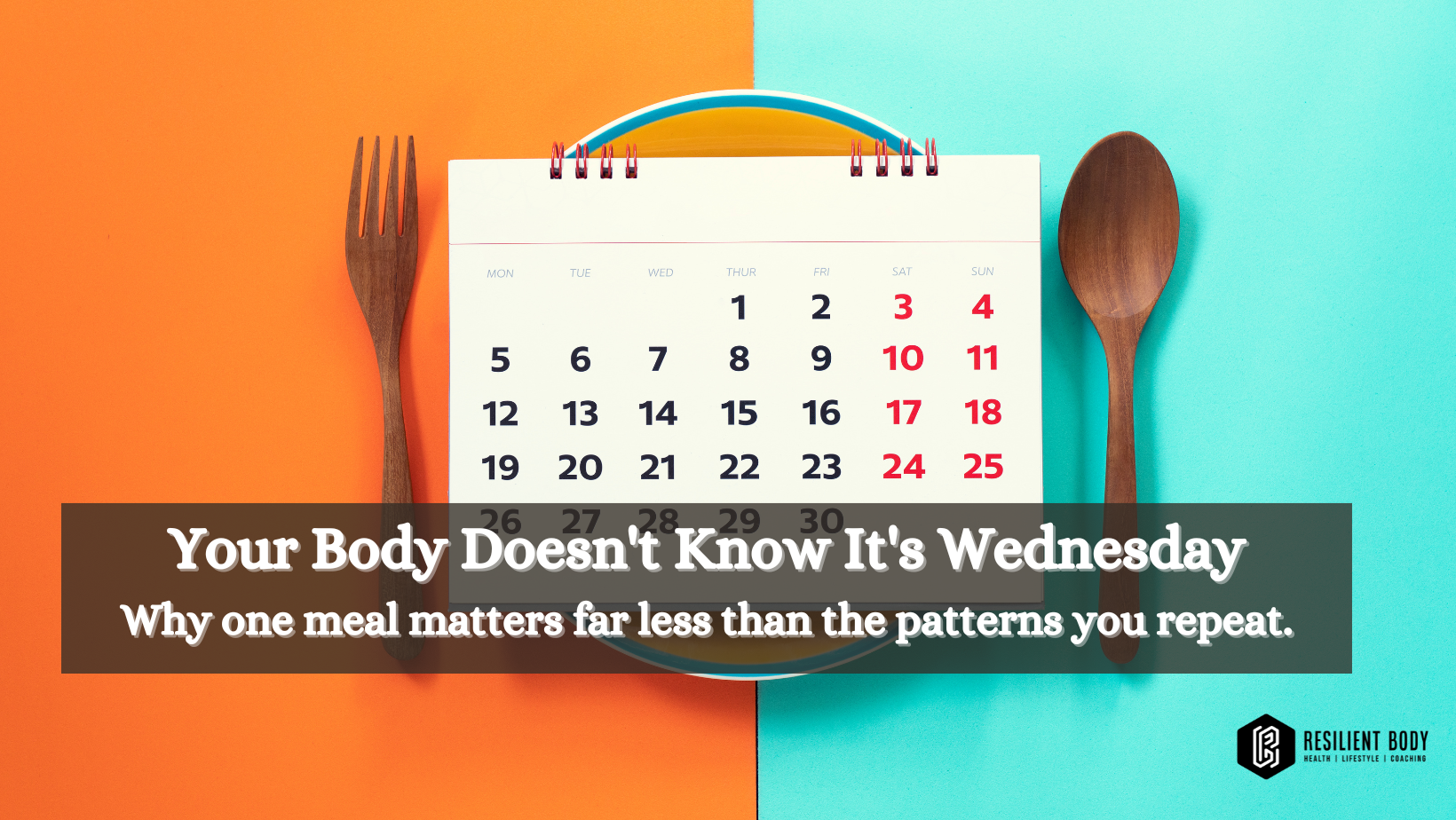
Not because it's hump day. And not because Wednesdays can sometimes feel like a bit of a slog.
I mean that literally.
Maybe today hasn't gone according to plan. Someone brought donuts into the office. Lunch ended up being a drive-thru burger between meetings. Dinner became pizza because your kid had practice and everyone got home late. By the time your head hits the pillow, you've convinced yourself you've "blown it," so you might as well enjoy the rest of the week and start over Monday.
Here's the good news: today probably doesn't matter nearly as much as you're giving it credit for.
Your body doesn't know it's Wednesday. It doesn't know you had pizza for dinner or skipped breakfast. It isn't handing out gold stars for grilled chicken or taking points away because you had dessert.
Instead, your body is constantly asking a much different question:
"Is this becoming the new normal?"
That's because your metabolism doesn't adapt to isolated meals. It adapts to the environment you repeatedly create.
One of the biggest misconceptions in nutrition is that our bodies respond dramatically to individual meals. Case in point are folks we hear lamenting their weekend getaway. We tend to treat every food choice like it's either moving us significantly toward better health or significantly away from it.
Fortunately, that's not how human physiology works.
One smashburger doesn't cause heart disease.
One salad doesn't reverse it.
One high-protein dinner doesn't build muscle.
One slice of birthday cake doesn't suddenly become body fat overnight.
Those are individual data points. Your body responds to the pattern they create.
Your Body Is Always Learning
People often think of metabolism as a fixed engine that burns a certain number of calories every day. In reality, it's remarkably adaptive.
As your eating habits, body weight, and activity levels change over time, your body gradually adjusts energy expenditure, appetite, and even how much you move without consciously thinking about it. Researchers refer to part of this process as adaptive thermogenesis, and it's one of the reasons your metabolism isn't a simple calculator.
The same principle shows up throughout nutrition research. Whether researchers are studying heart disease, diabetes, body composition, or longevity, the conversation has shifted away from individual foods and toward overall dietary patterns. Organizations like the American Heart Association now emphasize healthy eating patterns over labeling foods as simply "good" or "bad," while metabolic ward research from scientists like Dr. Kevin Hall continues to demonstrate that meaningful changes in body composition are driven by sustained habits rather than isolated meals.
Your body is incredibly smart.
It doesn't overreact to Wednesday.
It waits to see what Thursday, Friday, next week, and next month look like before making meaningful adaptations.
Healthy Eating Should Look... Healthy
One thing people are often surprised to hear is that I eat pizza with my family almost every Sunday.
They're usually even more surprised when I tell them I enjoy some form of dessert at night or pastries each week.
That's not because I have a magical metabolism or because calories somehow stop counting on weekends.
It's because those meals exist within the context of an overall dietary pattern.
The rest of my week is built around meals that support my goals. I eat plenty of protein. Fruits and vegetables show up regularly. Most of my meals are built from minimally processed foods (or processed in ways that enhance their nutrient content and/or absorption), and my portions generally match my activity level and energy needs.
Sunday pizza isn't competing with that pattern. It's part of the pattern.
Healthy eating shouldn't be so fragile that one pizza night or dessert with your family sends everything off the rails. In fact, I'd argue the opposite. One hallmark of a sustainable nutrition plan is that it has enough flexibility to include those moments without making you feel like you've failed.
That's also why I hesitate when people credit the success of certain dietary patterns entirely to the food itself.
Take Mediterranean countries, for example. The food absolutely matters, but so does everything surrounding it. People often walk more. Meals are more social. Work schedules and vacation policies can reduce chronic stress. Family and community often play a larger role in daily life. Those factors influence health too, yet they're frequently bundled together and credited solely to "the Mediterranean diet."
That's one reason I'm much more interested in principles than copying someone else's menu. And it’s definitely why we look at the person in front of us and what their life is like when clients ask about how they can nourish themselves better.
Build Patterns Worth Repeating
At Resilient Body, we rarely start by telling someone exactly what to eat. Most people don't need another rigid meal plan. They need a framework they can follow on a busy Wednesday, during a family vacation, or after a long day at work.
One simple place to start is what we call Protein & Plants First.
Before worrying about carbohydrates, fats, supplements, or calories, ask yourself:
"Where are my protein and plants?"
Not because protein and vegetables are magically more filling than every other food. Satiety is influenced by many factors, including fiber, water content, food volume, food processing, and even individual preference.
We prioritize protein and plants because they're two of the most consistently under-consumed food groups while providing an incredible amount of nutritional value. Protein supports muscle maintenance, recovery, healthy aging, and overall function. Fruits and vegetables provide fiber, vitamins, minerals, and countless naturally occurring compounds associated with better long-term health.
Once those are accounted for, the rest of the plate becomes much easier to build.
From there, focus on patterns that are actually repeatable:
Build meals around protein and plants first.
Choose minimally processed foods more often than not unless the processing enhances their nutrient content or absorption.
Leave room for pizza nights, birthday cake, vacations, and the foods you genuinely enjoy.
When life happens, simply return to your normal routine at the next meal.
Judge your nutrition by what a typical month looks like, not what happened yesterday.
The healthiest dietary patterns in the world don't all eat the same foods.
What they share are principles, not menus.
The Next Time It's Wednesday...
So if today is Wednesday, and it wasn't your best day nutritionally, don't panic.
Your body doesn't know it's Wednesday.
It also doesn't know the number on the scale tomorrow morning may be temporarily higher because you ate more carbohydrates or sodium than usual. Those meals often increase glycogen stores and the water that comes with them, not body fat overnight.
What your body does know is whether today's choices represent an exception or your normal routine.
That's incredibly encouraging because it means your health isn't determined by one meal, one day, or even one weekend.
It's shaped by the patterns you repeat often enough that your body begins to adapt to them.
Your body doesn't know it's Wednesday. It only knows what your Wednesdays usually look like.

📣 Quick Announcements:
July Challenge is in full swing this week so get ready … For Time and in order: 1K C2 SkiErg, 1K C2 RowErg, 1K C2 BikeErg. What will be the time to beat?! Can you beat your coaches?? We look forward to having some fun with it and suffering along with you!
New Program Block Starts Next Week! Get ready for some new movements and focus as we move into a new block of training next week. We think you will enjoy it! ALL workouts are also now live in our app
Bring a friend and you are both free on either class Saturday morning! If they sign up, receive $100 off your package.
New Personal Training Slots Available – Book a consult if you’re ready to level up
💬 Got questions? Reply here or ask your coach next time you're in